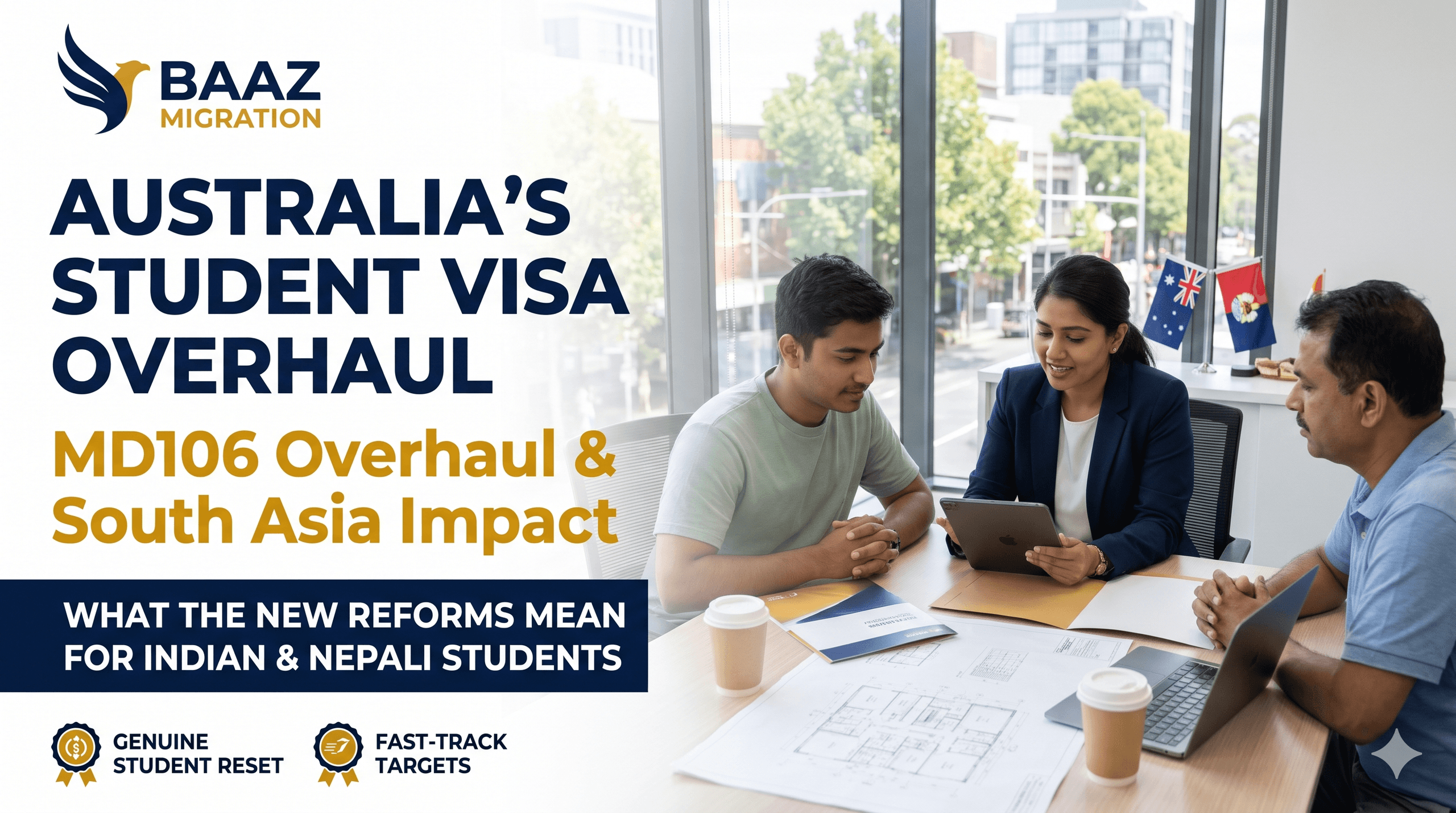
Australia’s Student Visa Reset: What the MD106 Overhaul Means for Indian and Nepali Students
Rapid policy shifts have shaken Australia’s international education sector. Consequently, students from South Asia face unpredictable processing times and record-high offshore refusal rates. In fact, government leaders admit that strict visa rules now scare away genuine students.
On 30 October 2026, the Australian Government announced a major reset of its student visa assessing standards. Specifically, officials targeted Ministerial Direction 106 (MD106) for a full replacement. This instrument directs case officers on how to evaluate the core Genuine Student (GS) test.
At Baaz Migration, we believe transparency empowers applicants. Below, we explain the latest announcements, distinguish law from proposals, and outline steps to protect your visa chances.
The Background: Why Australia is Revamping MD106
Over recent months, offshore refusal rates surged for applicants from India and Nepal. Case officers currently assess student applications under MD106. However, many critics argue that this framework produces inconsistent and subjective decisions. Consequently, genuine applicants often face refusals over rigid paperwork checks.
Assistant Minister for International Education Julian Hill addressed these issues on 30 October 2026. He emphasized that Australia needs high-calibre international scholars. Therefore, the government launched formal consultations to replace MD106 with a fairer model.
1. The 30 October 2026 Announcement: Key Takeaways
Minister Julian Hill outlined urgent administrative updates during his speech:
- 5-Day Fast-Track Target: The Department now prioritizes offshore applications from continuing students. Caseworkers aim to decide complete files within a rapid 5-day window.
- Focus on Academic Progression: For higher education candidates, officers will prioritize real academic progression over generic personal statements.
- Decoupling Integrity Checks: The government plans to separate financial checks from genuine intention tests.
2. Proposed vs. In-Force: Knowing the Difference
Headlines often confuse future policy with existing law. Here is where the rules stand today:
| Legal Status | Policy Measures & Rules |
| Currently in Force (The Law Now) | • Case officers still assess Subclass 500 applications under the original MD106. • The standard AUD $29,710 savings requirement remains mandatory. • The 12-month provider transfer freeze applies until 30 June 2027. |
| Currently Proposed (Under Consultation) | • A complete replacement for MD106 separates intent from finances. • New rules may mandate holding funds in approved Australian bank accounts. • Interim measures will tighten documentary requirements for Level 3 risk countries. |
3. The Core of the Proposed MD106 Replacement
The Department’s public consultation runs until 23 November 2026. This proposed overhaul addresses two critical friction points:
A. Separating Finances from Student Intent
Historically, case officers often merged financial scrutiny with study intentions. A paperwork doubt often triggered a Genuine Student refusal. The new framework evaluates genuine intentions and financial resources independently.
B. Ending Formulaic Personal Statements
Home Affairs wants to scrap repetitive, agency-written statements. Instead, applicants will answer targeted questions directly within the visa form. In addition, officers will give favorable weight to Transnational Education (TNE) pathways.
4. Tougher Integrity Measures and Appeals (From 1 Nov 2026)
The government also tightened broader immigration integrity laws. Under the Migration Amendment Regulations 2026 (F2026L01448), two strict rules took effect on 1 November 2026:
- Upfront ART Merits Review Fee: Applicants seeking review of a protection refusal must now pay an upfront fee of A$1,863.50. This fee deters unmeritorious tribunal appeals.
- No Bridging Visa B (BVB) Travel: The government now blocks BVB travel rights for onshore protection applicants who apply on or after 1 November 2026.
These rules focus on onshore protection claims, but they signal zero tolerance for visa loopholes. Therefore, students must lodge strong, fully compliant applications from the start.
5. What Should Indian and Nepali Students Do Right Now?
Because current MD106 rules still govern visa lodgements today, applicants should take these protective steps immediately:
- Demonstrate Clear Academic Progression: Choose an Australian course that builds logically on your past studies or work experience.
- Prepare Verifiable Financial Evidence: Maintain clear, traceable financial proof (AUD $29,710 minimum) in legitimate bank accounts.
- Write Original Genuine Student (GS) Answers: Avoid copied agency templates. Clearly explain why this qualification benefits your career back home in India or Nepal.
- Consult Registered Migration Agents (MARA): Engage accredited professionals early to prevent simple documentation errors.
How Baaz Migration Can Support Your Journey
Navigating student visa requirements demands careful planning and solid documentation. At Baaz Migration, our MARA-registered practitioners guide you through every step:
- Parramatta Office: Level 6, 150 George Street, Parramatta, Sydney NSW 2150
- Direct Contact: 0416 421 434 / 0424 030 033
- Email Support: jasmine@baazmigration.com | info@baazmigration.com
- Consultations: Book your strategy session online at Baaz Migration
Ready to start your Australian journey?
Book a consultation with our MARA registered team.